
Headlines
You are using an out of date browser. It may not display this or other websites correctly.
You should upgrade or use an alternative browser.
You should upgrade or use an alternative browser.
IHRA Safety and Rescue Overview
- Thread starter Bobcat
- Start date


Ratickle
Founding Member / Super Moderator
The safety mess is even getting bigger. They put out an advertisement for divers wanted to do safety rescue. Come take a 2 day class if you're a certified open water scuba diver and we will make you a rescue diver. 
It doesn't even come close to the PADI minimum requirements to even begin training to be a certified rescue diver.
That's who you want to trust your life to? Just like Joey Gratton......
It doesn't even come close to the PADI minimum requirements to even begin training to be a certified rescue diver.
That's who you want to trust your life to? Just like Joey Gratton......

Serious News
What's Happening
From what we have been told, the issue started with IHRA's insistence that SSR obtained their own insurance and name IHRA as additional insured. Up until this, the promoters paid APBA to make sure they were insured by APBA, and the promoters and APBA made sure that the location and all personnel used for safety, patrol boats, etc. were named as additional insured with a large amount total, and per incident. SSR tried to come to an agreement with IHRA to do so, as they are friends with many of the teams and have worked with all of them to make the boats safer, and to make sure their team understand the nuances of every boat, and special concerns of every racer, out there.
Serious News
What's Happening
While that was occurring, IHRA put up a post for rescue divers to fill their openings, deciding that when SSR refused to lower their standards, they would replace them.
Their rulebook showed:
.
2.2.2 Emergency Rescue Personnel — Sufficient recue divers will be required to staff the rescue boats and Helo. Rescue personnel that are SFI Rescue Diver certified and EMT certification equivalent or above with experience in public safety under emergency conditions and trained in offshore powerboat safety, vetted by the safety and rescue director shall only be considered for safety staffing. The Safety and Rescue Director will be responsible for staffing.
And their post for people showed:
"The Rescue Diver role carries lower requirements. Offshore racing experience is listed as preferred rather than mandatory. The core qualifications are EMT-B, SFI certification, and advanced open-water credentials. Both postings note that SFI classes will be provided by IHRA, confirming recruits are not expected to already hold motorsports-specific certification".
A very good article: https://powerboat.news/ihra-seeks-rescue-divers-seven-weeks-before-season-opener/
And they would utilize Darkside and Motorsports Rescue Association to achieve the above referenced SFI Rescue Diver Certification. They would start with an Open Water certified diver, spend one day in class and one day in the water, and they would be a SFI Certified Rescue Diver.
The issue, when SFI found out they were doing this, SFI notified them that SFI has never certified rescue divers for any boat racing types, and sent them a cease and desist letter. They also put out that they were APBA Certified to train, but they were not. APBA has also sent them a cease and desist letter. https://motorsportsrescue.com/dive-rescue/
Day One is all Lecture
Their rulebook showed:
.
2.2.2 Emergency Rescue Personnel — Sufficient recue divers will be required to staff the rescue boats and Helo. Rescue personnel that are SFI Rescue Diver certified and EMT certification equivalent or above with experience in public safety under emergency conditions and trained in offshore powerboat safety, vetted by the safety and rescue director shall only be considered for safety staffing. The Safety and Rescue Director will be responsible for staffing.
And their post for people showed:
"The Rescue Diver role carries lower requirements. Offshore racing experience is listed as preferred rather than mandatory. The core qualifications are EMT-B, SFI certification, and advanced open-water credentials. Both postings note that SFI classes will be provided by IHRA, confirming recruits are not expected to already hold motorsports-specific certification".
A very good article: https://powerboat.news/ihra-seeks-rescue-divers-seven-weeks-before-season-opener/
And they would utilize Darkside and Motorsports Rescue Association to achieve the above referenced SFI Rescue Diver Certification. They would start with an Open Water certified diver, spend one day in class and one day in the water, and they would be a SFI Certified Rescue Diver.
The issue, when SFI found out they were doing this, SFI notified them that SFI has never certified rescue divers for any boat racing types, and sent them a cease and desist letter. They also put out that they were APBA Certified to train, but they were not. APBA has also sent them a cease and desist letter. https://motorsportsrescue.com/dive-rescue/
Day One is all Lecture
- APBA Requirements for Rescue Safety Diver
- Dive Rescue equipment
- Boat Staffing
- Personal Safety
- Type of Boats and Capsule Design
- Divers’ Equipment
- Type of Crashes
- Fire Fighting
- Extrication
- Managing a dive emergency
- Dive Rescue Procedures
- Driver treatment in the water
- Driver Removal in and out of water
- When to Respond
Day Two in water skills
- Swim Test
- Extrication Tools
- Driver Ejected
- First Aid in the water
- Bleeding
- Not Breathing
- Reeves stretcher
- Single Capsule Rescue
- Driver Trapped
- Driver Removal
- First Aid in the water
- Driver removal upright capsule
- Dual Capsule Rescue
- Driver Trapped
- Driver Removal
- First aid in the water
- Helicopter Operations
Serious News
What's Happening
Then Leah, IHRA President, sent out this letter, (In two parts due to size restrictions):
| ||
|
Serious News
What's Happening
How Offshore Safety Actually Works
There has also been confusion—intentional or otherwise—about how safety, rescue, and medical care function at an offshore race.
Let’s be clear:
· Divers are divers. Their role is rescue, extraction, and in-water response.
· Once a patient is removed from the water, care transitions immediately to medical professionals operating within the local medical jurisdiction.
· That is exactly why on-site ambulances and licensed medical teams are required and present.
· IHRA’s structure ensures a clean, legally compliant handoff from rescue to medical care—every time.
This is not unique to IHRA. It is the standard across professional motorsports and large-scale events.
Defined Roles, Clear Accountability
IHRA’s safety structure is intentionally defined and layered:
· Safety Director
o Oversees all safety operations, personnel, protocols, and compliance with IHRA rules and insurance requirements.
· Medical Director
o Oversees all medical response, EMS coordination, hospital interface, and jurisdictional compliance.
· Lead Diver
o Oversees in-water rescue operations and dive teams, operating within defined scope and credentials.
Each role has specific minimum qualifications. Those requirements are not suggestions. They are the backbone of our insurance, our legal protection, and our moral responsibility.
Insurance Is Not a Bad Word—It’s a Reality
There has been an attempt to portray IHRA’s emphasis on insurance as somehow excessive or unnecessary. That argument does not hold up.
General liability insurance is a standard requirement across every professional event environment:
· The food vendor on the street
· The helicopter operator in the air
· The crane company on site
· The sanctioning body itself
Insurance does not weaken a sport—it protects it. And deviation from written safety rules is how coverage is lost.
Why Change Was Necessary
Relying on “how things have always been done” is precisely how offshore racing has found itself repeatedly exposed to risk, instability, and litigation. In this specific instance, the sport narrowly avoided what can only be described as a litigation and insurance time bomb.
That had to change.
Building a World-Class Safety Team
IHRA is committed to building a world-class offshore racing safety program. Do we wish everyone could be part of it? Of course. But participation requires:
· Meeting minimum qualifications
· Willingness to work as a team
· Willingness to grow, evolve, and improve
We cannot—and will not—accept unsafe or non-compliant practices simply because change is uncomfortable.
A Unified Direction Forward
It is important to emphasize that key leaders within offshore racing—including Dave and the Dark Side team—are aligned with this direction. Racers are not asking for chaos or constant reinvention. They are asking for a cohesive, professional team they can trust and build upon.
We understand this is not where anyone wanted to be. It is not where IHRA wanted to be either. But leadership requires action, not avoidance.
Final Word
IHRA will continue to:
· Put safety first
· Enforce its rules consistently
· Protect racers, promoters, host cities, and the sport itself
· Build a future-focused offshore racing program grounded in professionalism, accountability, and trust
That is not negotiable.
Leah Martin
President
International Hot Rod Association (IHRA)
There has also been confusion—intentional or otherwise—about how safety, rescue, and medical care function at an offshore race.
Let’s be clear:
· Divers are divers. Their role is rescue, extraction, and in-water response.
· Once a patient is removed from the water, care transitions immediately to medical professionals operating within the local medical jurisdiction.
· That is exactly why on-site ambulances and licensed medical teams are required and present.
· IHRA’s structure ensures a clean, legally compliant handoff from rescue to medical care—every time.
This is not unique to IHRA. It is the standard across professional motorsports and large-scale events.
Defined Roles, Clear Accountability
IHRA’s safety structure is intentionally defined and layered:
· Safety Director
o Oversees all safety operations, personnel, protocols, and compliance with IHRA rules and insurance requirements.
· Medical Director
o Oversees all medical response, EMS coordination, hospital interface, and jurisdictional compliance.
· Lead Diver
o Oversees in-water rescue operations and dive teams, operating within defined scope and credentials.
Each role has specific minimum qualifications. Those requirements are not suggestions. They are the backbone of our insurance, our legal protection, and our moral responsibility.
Insurance Is Not a Bad Word—It’s a Reality
There has been an attempt to portray IHRA’s emphasis on insurance as somehow excessive or unnecessary. That argument does not hold up.
General liability insurance is a standard requirement across every professional event environment:
· The food vendor on the street
· The helicopter operator in the air
· The crane company on site
· The sanctioning body itself
Insurance does not weaken a sport—it protects it. And deviation from written safety rules is how coverage is lost.
Why Change Was Necessary
Relying on “how things have always been done” is precisely how offshore racing has found itself repeatedly exposed to risk, instability, and litigation. In this specific instance, the sport narrowly avoided what can only be described as a litigation and insurance time bomb.
That had to change.
Building a World-Class Safety Team
IHRA is committed to building a world-class offshore racing safety program. Do we wish everyone could be part of it? Of course. But participation requires:
· Meeting minimum qualifications
· Willingness to work as a team
· Willingness to grow, evolve, and improve
We cannot—and will not—accept unsafe or non-compliant practices simply because change is uncomfortable.
A Unified Direction Forward
It is important to emphasize that key leaders within offshore racing—including Dave and the Dark Side team—are aligned with this direction. Racers are not asking for chaos or constant reinvention. They are asking for a cohesive, professional team they can trust and build upon.
We understand this is not where anyone wanted to be. It is not where IHRA wanted to be either. But leadership requires action, not avoidance.
Final Word
IHRA will continue to:
· Put safety first
· Enforce its rules consistently
· Protect racers, promoters, host cities, and the sport itself
· Build a future-focused offshore racing program grounded in professionalism, accountability, and trust
That is not negotiable.
Leah Martin
President
International Hot Rod Association (IHRA)
Serious News
What's Happening
So, after that was posted, the response from Michael Allweiss was:
Entire Response, (Too long to post the entire response in a single post):

 speedonthewater.com
As a former offshore racer, former Chairman of the APBA Offshore Racing Commission, and legal counsel for the families of racers who lost their lives—and competitors who were gravely injured—due to documented medical and safety failures at sanctioned events, I do not approach offshore safety as a talking point or branding exercise.
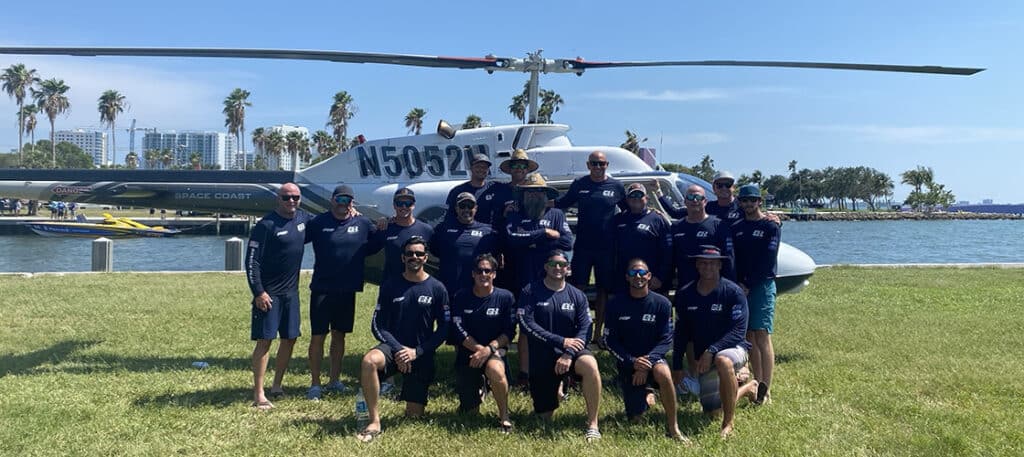
Michael Allweiss is the attorney for Shawn Steinert (far left), who leads the SSR Safety and Rescue Services crew.
I have seen what happens when command authority is unclear, when credentials are misunderstood or misused, and when responsibility is separated from control. I have read the transcripts. I have litigated the consequences. My involvement here is driven by those experiences—not by optics, politics or personal loyalty.
Those experiences, and my shared commitment for protecting racers, are precisely why Shawn Steinert and J.R. Anderson sought my assistance in addressing issues raised in discussions with IHRA leadership, including President Leah Martin, Director of Offshore Powerboating Tommy Thomassie and newly appointed Director of IHRA Safety, Justin Martin.
To be clear, my involvement here reflects professional judgment shaped by direct experience with offshore racing governance failures—not automated drafting tools, public relations strategies, or secondhand narratives.
I. Why This Response Exists
IHRA President Leah Martin’s recent “Open Letter” to race teams is not a clarification of safety policy. It is a public communication that targets Shawn Steinert, personally, and SSR Safety & Rescue while framing disputed governance issues as credential failures.
It contains:
• demonstrably false factual assertions,
• misleading legal conclusions,
• selective disclosure of information,
• and a clear effort to shift blame and justify a pre-determined outcome.
This response exists to set the record straight, identify material misrepresentations, and explain why SSR could not—and would not—participate in the structure IHRA attempted to impose.
II. The Public Criticism of Shawn Steinert Was Unwarranted and Unsupported.
Shawn Steinert did not refuse safety standards, insurance, training, or collaboration.
What he did do, consistently and professionally, was ask basic governance questions that any responsible rescue provider must ask:
• Who has authority during an on-water emergency?
• Who controls staffing and team composition?
• How is responsibility aligned with accountability if something goes wrong?
Instead of answering those questions, IHRA escalated to a public attack on Shawn’s professional credentials.
That choice raises an obvious question: Why was it necessary to attack Shawn personally at all? The answer appears self-evident: because Shawn would not endorse a structure that stripped SSR of authority while leaving it exposed to responsibility, and racers to the very real risk of injury and death
(Omissions were done here)
IV. The EMT Allegation is Factually Wrong and Professionally Damaging
IHRA’s letter asserts that the EMT certification of the individual serving as Safety Director at recent events “expired in 2022,” and implies this created an insurance and liability crisis.
This assertion is materially misleading.
Under the offshore rules framework governing SSR’s prior operations (APBA and WPRA), “EMT certification” refers to completion of EMT training, not active state medical licensure. EMT training certificates do not expire. State EMT licenses expire but are required only when an individual is practicing medicine under a medical director.
Shawn Steinert was not practicing medicine. He was performing rescue coordination, extraction, stabilization, and transfer to licensed medical professionals.
Conflating training certification with medical licensure and then invoking that conflation to suggest regulatory violations and insurance exposure, is not supported by the governing rules. It constitutes a material misrepresentation that directly harms professional reputation.
Moreover, by all objective accounts, Shawn and his 50-plus qualified and experienced SSR teammates have repeatedly performed effective, timely rescues that have saved lives. For more than a decade, SSR’s safety program has been widely regarded within offshore racing as reliable and effective.
Which raises an unavoidable question: why the abrupt shift from public praise to public disparagement?
V. IHRA’s Insurance Narrative is a Smokescreen
SSR never refused to carry insurance. SSR accurately explained that offshore racing has historically operated under promoter-held event policies covering racers, officials, and safety personnel—a structure well understood by experienced offshore promoters and sanctioning bodies, including individuals within IHRA leadership.
When IHRA asserted additional insurance requirements, SSR asked:
• who required them,
• under what policy,
• and whether SSR could speak with the insurer or broker. IHRA never provided that information.
Despite this, IHRA’s letter claims the sport “narrowly avoided a litigation and insurance time bomb.” No insurer, policy provision, underwriting letter, or coverage determination has ever been produced to support that claim. And again, it belies the truth.
Speculation is not evidence. When presented as fact in a public letter, it creates reputational harm without factual support.
(Omissions were done here)
VII. The SFI “Motorsports Rescue” Certification Does Not Resolve Offshore Safety Concerns
SSR does not dispute SFI’s credibility in equipment certification, particularly in automotive racing disciplines.
Shawn and J.R., along with leadership within APBA’s safety structure, have raised concerns not with SFI generally, but with the application of an SFI-administered Motorsports Rescue certification as a “minimum and controlling standard” for offshore powerboat rescue operations. In other words, SSR does dispute the legitimacy of an SFI-administered offshore rescue certification that lacks:
• The Motorsports Rescue curriculum or training standards.
• Information regarding who developed the program and their offshore racing or marine rescue experience.
• The offshore incidents, risk models, or operational protocols on which the program is based; or
• An explanation of how this certification meaningfully supplements or supersedes established offshore rescue training and experience.
As has been explained to IHRA on numerous occasions, absent that information, SSR cannot assess the program’s offshore applicability or responsibly treat it as a controlling qualification. To that end, safety experts have tried to secure this information directly from SFI, to no avail.
Simply put, offshore rescue is fundamentally different from equipment certification or land-based motorsports safety, and the basis for extending this program into that environment has not been articulated.
The involvement of individuals associated with prior offshore safety failures—documented in sworn testimony and litigation arising from the Joey Gratton tragedy—in the development or promotion of this program raises serious ethical and professional concerns. Elevating such a program while simultaneously attacking SSR’s proven track record defies logic and undermines trust.
VIII. Selective Transparency and Nepotism Concerns Should Matter.
IHRA publicly announced the hirings of:
• Gary Stray,
• Bob Teague,
• and Tommy Thomassie.
Yet IHRA did not disclose—until forced by public scrutiny—that Leah Martin’s husband, Justin, was privately installed as Safety Director.
That omission matters. Why? Because, the two sets of draft Safety Rules IHRA sent to Shawn reduced SSR from an integrated safety organization to a pool of individual hires under centralized control. And that control is vested exclusively in the Safety Director. In point of fact, under that model the IHRA Safety Director:
• selects the divers,
• controls staffing,
• defines roles,
• but the Lead Diver (the position IHRA invited Shawn and JR to apply for) bears operational risk.
The publicly available record raises serious questions about whether Mr. Martin possesses the offshore rescue experience typically required for such authority. IHRA has invited the public to assess that record for itself through recent interviews and statements.
(Omissions were done here)
XII. Conclusion
SSR Safety & Rescue has saved lives in offshore racing through:
• integrated teams,
• clear command structures,
• staffing control,
• and deep familiarity with boats, courses, and systems.
This did not need to become a public dispute. Shawn Steinert was criticized not because he was unsafe, but because he declined to legitimize a structure that compromised safety governance. Multiple respected rescue professionals reached the same conclusion. That avoidable and unnecessary outcome is the real tragedy here.
Editor’s note: A St. Petersburg, Fla.-based attorney representing Shawn Steinert, Michal Allweiss was the head of APBA Offshore LLC during the early 2000s. This rebuttal first appeared February 8 as a post. of Mr. Steinert’s Facebook page.
speedonthewater.com
Entire Response, (Too long to post the entire response in a single post):
A Rebuttal to IHRA President Leah Martin’s Open Letter to Racers
International Hot Rod Association
speedonthewater.com
A Rebuttal to IHRA President Leah Martin’s Open Letter to Racers
ByMichael AllweissFebruary 10, 2026As a former offshore racer, former Chairman of the APBA Offshore Racing Commission, and legal counsel for the families of racers who lost their lives—and competitors who were gravely injured—due to documented medical and safety failures at sanctioned events, I do not approach offshore safety as a talking point or branding exercise.
Michael Allweiss is the attorney for Shawn Steinert (far left), who leads the SSR Safety and Rescue Services crew.
I have seen what happens when command authority is unclear, when credentials are misunderstood or misused, and when responsibility is separated from control. I have read the transcripts. I have litigated the consequences. My involvement here is driven by those experiences—not by optics, politics or personal loyalty.
Those experiences, and my shared commitment for protecting racers, are precisely why Shawn Steinert and J.R. Anderson sought my assistance in addressing issues raised in discussions with IHRA leadership, including President Leah Martin, Director of Offshore Powerboating Tommy Thomassie and newly appointed Director of IHRA Safety, Justin Martin.
To be clear, my involvement here reflects professional judgment shaped by direct experience with offshore racing governance failures—not automated drafting tools, public relations strategies, or secondhand narratives.
I. Why This Response Exists
IHRA President Leah Martin’s recent “Open Letter” to race teams is not a clarification of safety policy. It is a public communication that targets Shawn Steinert, personally, and SSR Safety & Rescue while framing disputed governance issues as credential failures.
It contains:
• demonstrably false factual assertions,
• misleading legal conclusions,
• selective disclosure of information,
• and a clear effort to shift blame and justify a pre-determined outcome.
This response exists to set the record straight, identify material misrepresentations, and explain why SSR could not—and would not—participate in the structure IHRA attempted to impose.
II. The Public Criticism of Shawn Steinert Was Unwarranted and Unsupported.
Shawn Steinert did not refuse safety standards, insurance, training, or collaboration.
What he did do, consistently and professionally, was ask basic governance questions that any responsible rescue provider must ask:
• Who has authority during an on-water emergency?
• Who controls staffing and team composition?
• How is responsibility aligned with accountability if something goes wrong?
Instead of answering those questions, IHRA escalated to a public attack on Shawn’s professional credentials.
That choice raises an obvious question: Why was it necessary to attack Shawn personally at all? The answer appears self-evident: because Shawn would not endorse a structure that stripped SSR of authority while leaving it exposed to responsibility, and racers to the very real risk of injury and death
(Omissions were done here)
IV. The EMT Allegation is Factually Wrong and Professionally Damaging
IHRA’s letter asserts that the EMT certification of the individual serving as Safety Director at recent events “expired in 2022,” and implies this created an insurance and liability crisis.
This assertion is materially misleading.
Under the offshore rules framework governing SSR’s prior operations (APBA and WPRA), “EMT certification” refers to completion of EMT training, not active state medical licensure. EMT training certificates do not expire. State EMT licenses expire but are required only when an individual is practicing medicine under a medical director.
Shawn Steinert was not practicing medicine. He was performing rescue coordination, extraction, stabilization, and transfer to licensed medical professionals.
Conflating training certification with medical licensure and then invoking that conflation to suggest regulatory violations and insurance exposure, is not supported by the governing rules. It constitutes a material misrepresentation that directly harms professional reputation.
Moreover, by all objective accounts, Shawn and his 50-plus qualified and experienced SSR teammates have repeatedly performed effective, timely rescues that have saved lives. For more than a decade, SSR’s safety program has been widely regarded within offshore racing as reliable and effective.
Which raises an unavoidable question: why the abrupt shift from public praise to public disparagement?
V. IHRA’s Insurance Narrative is a Smokescreen
SSR never refused to carry insurance. SSR accurately explained that offshore racing has historically operated under promoter-held event policies covering racers, officials, and safety personnel—a structure well understood by experienced offshore promoters and sanctioning bodies, including individuals within IHRA leadership.
When IHRA asserted additional insurance requirements, SSR asked:
• who required them,
• under what policy,
• and whether SSR could speak with the insurer or broker. IHRA never provided that information.
Despite this, IHRA’s letter claims the sport “narrowly avoided a litigation and insurance time bomb.” No insurer, policy provision, underwriting letter, or coverage determination has ever been produced to support that claim. And again, it belies the truth.
Speculation is not evidence. When presented as fact in a public letter, it creates reputational harm without factual support.
(Omissions were done here)
VII. The SFI “Motorsports Rescue” Certification Does Not Resolve Offshore Safety Concerns
SSR does not dispute SFI’s credibility in equipment certification, particularly in automotive racing disciplines.
Shawn and J.R., along with leadership within APBA’s safety structure, have raised concerns not with SFI generally, but with the application of an SFI-administered Motorsports Rescue certification as a “minimum and controlling standard” for offshore powerboat rescue operations. In other words, SSR does dispute the legitimacy of an SFI-administered offshore rescue certification that lacks:
• The Motorsports Rescue curriculum or training standards.
• Information regarding who developed the program and their offshore racing or marine rescue experience.
• The offshore incidents, risk models, or operational protocols on which the program is based; or
• An explanation of how this certification meaningfully supplements or supersedes established offshore rescue training and experience.
As has been explained to IHRA on numerous occasions, absent that information, SSR cannot assess the program’s offshore applicability or responsibly treat it as a controlling qualification. To that end, safety experts have tried to secure this information directly from SFI, to no avail.
Simply put, offshore rescue is fundamentally different from equipment certification or land-based motorsports safety, and the basis for extending this program into that environment has not been articulated.
The involvement of individuals associated with prior offshore safety failures—documented in sworn testimony and litigation arising from the Joey Gratton tragedy—in the development or promotion of this program raises serious ethical and professional concerns. Elevating such a program while simultaneously attacking SSR’s proven track record defies logic and undermines trust.
VIII. Selective Transparency and Nepotism Concerns Should Matter.
IHRA publicly announced the hirings of:
• Gary Stray,
• Bob Teague,
• and Tommy Thomassie.
Yet IHRA did not disclose—until forced by public scrutiny—that Leah Martin’s husband, Justin, was privately installed as Safety Director.
That omission matters. Why? Because, the two sets of draft Safety Rules IHRA sent to Shawn reduced SSR from an integrated safety organization to a pool of individual hires under centralized control. And that control is vested exclusively in the Safety Director. In point of fact, under that model the IHRA Safety Director:
• selects the divers,
• controls staffing,
• defines roles,
• but the Lead Diver (the position IHRA invited Shawn and JR to apply for) bears operational risk.
The publicly available record raises serious questions about whether Mr. Martin possesses the offshore rescue experience typically required for such authority. IHRA has invited the public to assess that record for itself through recent interviews and statements.
(Omissions were done here)
XII. Conclusion
SSR Safety & Rescue has saved lives in offshore racing through:
• integrated teams,
• clear command structures,
• staffing control,
• and deep familiarity with boats, courses, and systems.
This did not need to become a public dispute. Shawn Steinert was criticized not because he was unsafe, but because he declined to legitimize a structure that compromised safety governance. Multiple respected rescue professionals reached the same conclusion. That avoidable and unnecessary outcome is the real tragedy here.
Editor’s note: A St. Petersburg, Fla.-based attorney representing Shawn Steinert, Michal Allweiss was the head of APBA Offshore LLC during the early 2000s. This rebuttal first appeared February 8 as a post. of Mr. Steinert’s Facebook page.
A Rebuttal to IHRA President Leah Martin’s Open Letter to Racers
International Hot Rod Association
speedonthewater.com
Serious News
What's Happening
Then, when others were researching IHRA, this came to light, causing more concern about safety standards possibly being lessened:
Ratickle
Founding Member / Super Moderator
Since that mess was a Michigan couple, I knew about it way back. The odd part to us, drag racing had changed to two fire/rescue crews years ago because of similar situations. The thing that they had found, if there is only a rescue/fire crew at the end of the course, (as what they had in this case), the team cannot even begin to get to an accident or fire at the start until both cars had come to a halt. So, a second crew was added at the start and the one at the end also stayed. I have no idea why that second crew at the start was removed in this case.
A minute and a half to get to a car on fire is ridiculous. Especially when the entire race track is only a quarter mile long. SSR had rescue divers at every accident in less than 30 seconds, and the race tracks are as long as 7 miles.
I'm sure I'll hear why they did not have a fire/rescue team and truck at the start like has been the norm for a long time, but there is really no good reason that I can think of. From everything they put out there it could not have been to save money as they tout they have almost unlimited funds, yet they seem to be doing something similar in offshore. Why cut corners on the most important thing in racing, sending everyone home healthy and in one piece at the end of the weekend. I don't get it.
A minute and a half to get to a car on fire is ridiculous. Especially when the entire race track is only a quarter mile long. SSR had rescue divers at every accident in less than 30 seconds, and the race tracks are as long as 7 miles.
I'm sure I'll hear why they did not have a fire/rescue team and truck at the start like has been the norm for a long time, but there is really no good reason that I can think of. From everything they put out there it could not have been to save money as they tout they have almost unlimited funds, yet they seem to be doing something similar in offshore. Why cut corners on the most important thing in racing, sending everyone home healthy and in one piece at the end of the weekend. I don't get it.

Ratickle
Founding Member / Super Moderator
You can see how long it takes here on a Facebook post. Guys running up in shorts and t-shirts with fire extinguishers, then the safety crew shows up from the other end of the track. I was told some of the guys trying to put the fire out, and save Marvin were also burned pretty bad.Then, when others were researching IHRA, this came to light, causing more concern about safety standards possibly being lessened:
Ratickle
Founding Member / Super Moderator
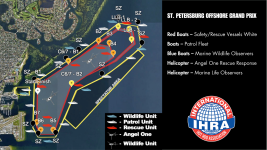
The feedback from St Pete for the safety group has not been positive.
Boat barrel rolled on the course, no red flag or even a yellow flag. Really pissed off the boats remaining on the course as they had to dodge debris as best as possible and go around the damaged boat.
Didn't make the occupants who have to wear capsule suits use their capsule suits during the dunker tests.
Had the safety patrol boats anchored next to turn buoys, one almost got hit when a race boat lost it.
No spotters on the turn boats.
Ran a short lap/long lap where boats a majorly different speeds had to merge.
And more......
One very experienced racer who was racing there said, "obviously the B team"......
Boat barrel rolled on the course, no red flag or even a yellow flag. Really pissed off the boats remaining on the course as they had to dodge debris as best as possible and go around the damaged boat.
Didn't make the occupants who have to wear capsule suits use their capsule suits during the dunker tests.
Had the safety patrol boats anchored next to turn buoys, one almost got hit when a race boat lost it.
No spotters on the turn boats.
Ran a short lap/long lap where boats a majorly different speeds had to merge.
And more......
One very experienced racer who was racing there said, "obviously the B team"......
Similar threads

- Replies
- 24
- Views
- 3K

